Thermal and Supply Planning for an 800x600 Micro OLED in AR Glasses
AR glasses fail their users in two ways that have nothing to do with image quality: they get uncomfortable, and they stop being repairable. Both are consequences of decisions taken early. A 0.32-inch 800x600 micro OLED with flexible interface options gives a designer room to reduce wiring and board area, which helps the thermal picture, but the thermal and supply questions still have to be worked through deliberately. The right time to answer them is while the optical and mechanical design is still fluid, because both constrain the shape of the product rather than sitting inside it.
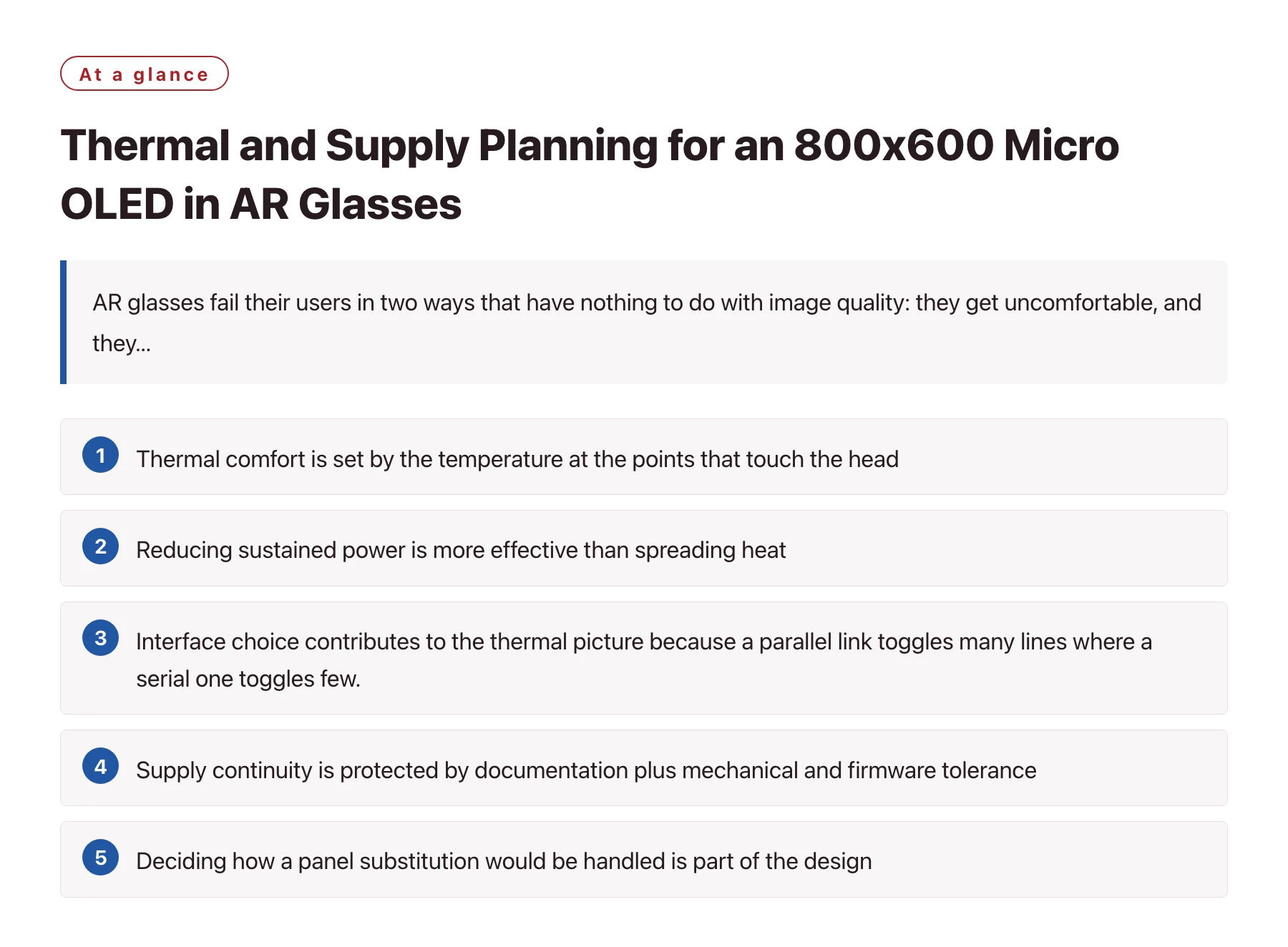
Key takeawaysThermal comfort is set by the temperature at the points that touch the head, not by the display's junction temperature. · Reducing sustained power is more effective than spreading heat, and it is easiest to achieve by dimming static content and reducing activity when nothing changes. · Interface choice contributes to the thermal picture because a parallel link toggles many lines where a serial one toggles few. · Supply continuity is protected by documentation plus mechanical and firmware tolerance, not by documentation alone. · Deciding how a panel substitution would be handled is part of the design, not a procurement afterthought.
A product worn on the head has an unusual thermal environment. It cannot use a fan, its surface area is limited, and part of that surface is in contact with skin that notices small changes. Heat that would be unremarkable in any other device becomes the reason a user takes the glasses off after twenty minutes.
The display is not the main heat source in most designs, but it is in the part of the product closest to the face, and the interface that drives it can add measurable dissipation. Both are controllable if they are treated as part of the thermal design rather than as constants.
Supply is the slower-burning risk. Products in this category are expected to be supported for years, and a panel that quietly changes makes service difficult. The mitigation is partly contractual and partly technical, and the technical half has to be designed in advance.
Where the heat actually is
Thermal problems in AR glasses are rarely caused by one hot component. They come from several modest sources sharing a small enclosure with a short path to skin. The display, its driver, the interface, the processor and the radio all contribute, and the user experiences the sum at the points where the frame touches the head.
That makes the useful measurement a surface temperature survey rather than a component temperature. Thermocouples at the brow, the temple and behind the ear, read after an hour of realistic use, describe the product far better than a junction temperature ever will.
It also changes the mitigation hierarchy. Spreading heat makes a device feel cooler for the same total dissipation, but reducing dissipation is more effective and usually cheaper. For the display specifically, the largest savings come from not driving brightness that nobody is looking at, and from reducing interface activity when the image is static. Choosing a 800x600 Micro OLED display with RGB interface at the start makes that interface-level saving something the design can use, rather than something that would require a change of panel and host later.
Thermal levers available to a display designer
| Lever | Effect | Cost or constraint |
|---|---|---|
| Dimming when idle or when the eye is not on the display | Directly reduces the largest display-related contribution | Requires a sensor or a usage model, and must not compromise legibility |
| Reducing refresh activity for static content | Cuts interface and driver dissipation without changing appearance | Adds firmware complexity and must not cause visible artefacts on update |
| Choosing a lower-power link | Fewer toggling lines mean less dynamic dissipation | Constrains the host architecture and may require a host with a serial display controller |
| Using the frame as a heat spreader | Lowers the temperature at any single contact point | Adds mass, and requires a thermal path from the electronics to the frame |
| Moving heat sources away from contact areas | Reduces what the user feels most acutely | Constrains layout and may lengthen cables, which has its own electrical cost |
Designing for a supply that lasts
A pair of AR glasses will be expected to last several years, and to be serviceable for most of that period. A panel that is revised or discontinued without notice turns a serviceable product into a redesign.
The technical half of the mitigation is tolerance: keep the display configuration as versioned data, avoid dimensioning the housing so tightly that no equivalent module could fit, and keep the interface abstracted so a substitute can be adapted in firmware rather than in silicon [1].
What documentation buys you
A notification period before a change, an agreed change-control process and a written definition of form, fit and function convert a supply risk into a scheduled engineering task. Without them the same event is an emergency, because the first information is usually the last shipment.
It is worth asking who makes the underlying panel as well as who assembles the module. Where those are different companies, there are two supply chains and the less predictable one sets the risk.
Temperature range is a design input, not a datasheet line
AR glasses will be left in a car, worn in winter and used immediately after coming indoors. Behaviour at the extremes of the storage and operating range therefore affects user experience directly, and it should be characterised rather than assumed [2]. A design that assumes room temperature will meet its first surprise in the field.
Material and recycling obligations add a second constraint on how a module may change over time [3]. Suppliers manage this routinely, but the changes they make to comply can affect adhesives and coatings, which is another reason to keep a short list of characteristics that must not change silently.
Write the thermal and supply plan before the industrial design is fixed, because both constrain it. An hour-long thermal survey and a one-page supply agreement are cheap at that stage. After tooling, the same two documents describe problems rather than decisions.
Sources
Frequently asked questions
How do I know whether AR glasses will be comfortable to wear?
Measure surface temperature at the contact points after at least an hour of realistic use, with several wearers if possible. Contact area and pressure vary between people, so the same temperature can be comfortable for one user and noticeable for another. Design for the worst realistic contact geometry rather than an average.
Does the display interface affect thermal behaviour?
It can. A parallel interface toggles many lines at high frequency, while a serial one toggles far fewer, so the dynamic dissipation differs. In a small worn enclosure even a modest difference is worth considering, particularly because the display electronics sit close to the face.
What is the most effective way to reduce display heat in AR glasses?
Reduce the light and activity you do not need. Dimming when the user is not looking, and reducing refresh activity when the image is static, cut dissipation without changing what the user sees. Spreading heat helps comfort but does not reduce the total that has to leave the device.
How should long-term supply risk be handled for a wearable display?
Combine commercial and technical measures. Negotiate notification periods and a change-control process, and design so a substitute is possible: versioned display configuration, abstracted interface, and mechanical tolerance around the module. A written agreement without design tolerance still leaves a redesign, and design tolerance without notice still leaves a surprise.