Seventy-Two Hours in a Hosted Hall, Including the Bad Hour
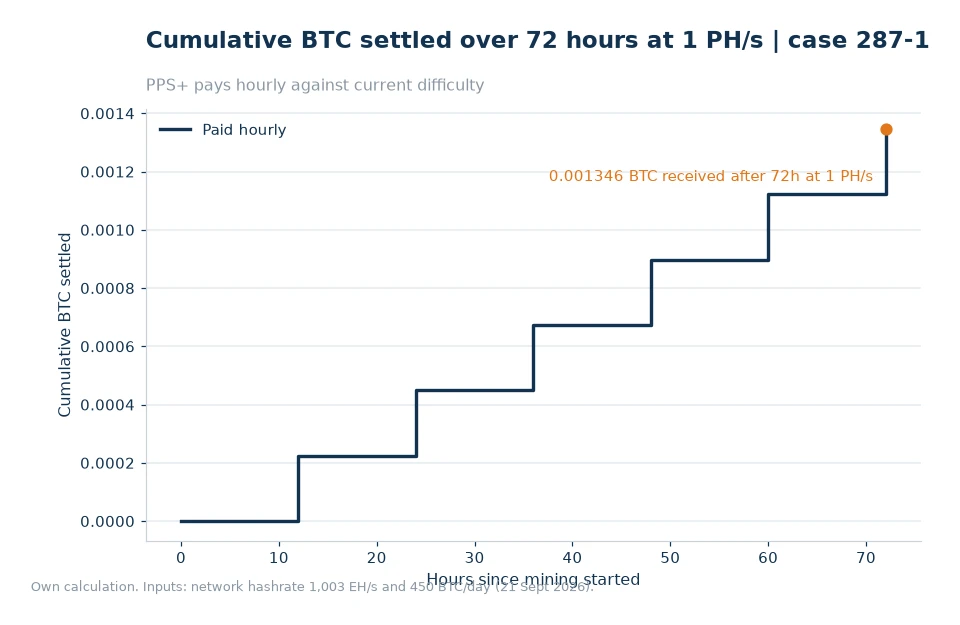
A facility tour shows you the clean version of a hosting operation. Seventy-two hours of credits shows you the real one. At 1 PH/s a flawless run settles 0.00134582 BTC, worth $113.98 at $84,692, and a single two-hour outage removes 0.00003738 BTC from that total, or about $3.17. Small numbers, until they repeat every month.

Key takeaways
- Seventy-two hours at 1 PH/s produces 0.00134582 BTC if the machine never stops.
- Each lost hour costs 0.00001869 BTC, so a two-hour outage removes $3.17 of value at $84,692.
- A run of four lost hours leaves 0.00119629 BTC, which is 11% less than a clean window.
- Asking for the outage log tells you more than any number of site photographs.
Three days shows a facility's true rhythm
Long enough to include a shift change, a cooling cycle and one real piece of maintenance, and short enough that the answer arrives while the decision still matters. A hosted operation that looks immaculate at eleven in the morning may tell a different story at three, when the afternoon heat loads the chillers and the staff are busy elsewhere.
Three days also crosses a weekend boundary in most cases, which is exactly when a facility's staffing model shows itself. A hall with nobody on site from Friday evening to Monday morning is not necessarily a bad hall, but the owner should know that a failed fan will wait. The payout history is the only honest record of how often that happens, and it is the first document to request when a contract is being negotiated.
It is worth running the audit on a machine you already know. If the same rig produced a clean staircase at home and a ragged one in the hall, the change is the facility, not the hardware. That comparison costs nothing and removes the most common excuse in a hosting dispute, which is that the machine was always unreliable.
The credit curve when nothing fails
Under PPS+ the block-reward component settles every hour against current difficulty, so the balance climbs in steps of 0.00001869 BTC at 1 PH/s. Over three days that is 72 steps and 0.00134582 BTC. The regularity is the diagnostic tool: a clean staircase means the machine submitted shares in every hour of the window.
Because the steps are equal, any gap stands out without arithmetic. A miner does not need a dashboard to notice that Friday night is missing a block of steps; the shape of the line says it. That is a far better early warning than a monthly average, which can absorb a lost weekend and still look plausible to anyone reading a summary.
Keep the window honest by recording the start and end balances rather than trusting a screenshot taken at an odd hour. The difference between two timestamps is the only figure that can be compared with the table below, and it is the figure a provider will accept in a discussion about a credit that did not arrive.
What lost hours cost
The table assumes the same 1 PH/s machine and prices every scenario at $84,692. The middle column counts hours actually online, not hours contracted.
| Scenario | Hours online | BTC settled | Value |
|---|---|---|---|
| Clean window | 72 | 0.00134582 | $113.98 |
| One 2-hour stop | 70 | 0.00130844 | $110.83 |
| Two 2-hour stops | 68 | 0.00127106 | $107.65 |
| Eight hours down | 64 | 0.00119629 | $101.31 |
The last row is the one to hold against a hosting invoice. Eight hours offline in a 72-hour window is an 11% production loss, and if the fee is charged for the full period regardless, the effective cost per delivered coin rises accordingly. That is a contract question, and the table is the evidence you bring to it. It is also the reason a provider's uptime clause deserves more attention than its photographs of the hall.
Worked example
Reduce the window by one hour and watch the figures move.
- Daily output at 1 PH/s: 1,000 × 0.00000044865 = 0.00044861 BTC.
- Hourly credit: 0.00044861 ÷ 24 = 0.00001869 BTC.
- Seventy-two hours: 72 × 0.00001869 = 0.00134582 BTC.
- Value: 0.00134582 × 84,692 = $113.98.
- Two lost hours: 2 × 0.00001869 = 0.00003738 BTC, or $3.17.
- Seventy hours online: 70 × 0.00001869 = 0.00130844 BTC, or $110.83.
- Eight lost hours: 64 × 0.00001869 = 0.00119629 BTC, or $101.31, an 11.1% shortfall.
Questions that belong in a site visit
Walk in with four questions and write down the answers. What is the contracted uptime, and how is it measured: at the machine, at the rack, or at the building? What happens to the fee during an outage that the facility caused? Who holds spare parts, and how quickly can a power supply be replaced? What notice does a miner need to give before removing hardware?
Answers that come quickly and in writing are worth more than a polished hall. A provider who hesitates on the uptime clause is telling you something useful, and a provider who offers an outage log without being asked is telling you something better. ViaBTC Mining Farms and the Miner Hosting directory can shorten the search, but the four questions still decide the contract.
Add a fifth question about metering. Is the fee based on the machine's rated draw or on a meter at the rack? The difference matters when a unit runs below its nameplate after a repair. A meter is fair to both sides; a rating is a guess that always favours whoever wrote the contract.
Finally, ask how the provider reports an incident. A short written note with a timestamp and an affected rack is worth more than a verbal apology, because it can be checked against the pool's own record. Facilities that keep such notes tend to have fewer incidents to explain, which is not a coincidence, and the habit also makes a monthly reconciliation much shorter.
Redundancy you can check from a dashboard
Redundancy is easy to claim and hard to see. The pool account gives an independent view: hashrate reported by the worker, hour by hour, without the facility's own dashboard in between. If the facility says the rack was online and the pool shows a gap, the pool is the record that matters for payment, because payment follows submitted shares.
The live pool state adds context for those gaps. If the pool's own hashrate dipped at the same moment, the cause may have been upstream rather than local. If the pool was steady and your worker was not, the fault is inside the building. That single comparison saves a lot of guessing.
Frequently asked questions
How much does one hour of downtime cost at 1 PH/s?
One hour forgoes 0.00001869 BTC, which is $1.58 at $84,692. A two-hour stop removes 0.00003738 BTC, or about $3.17, from a 72-hour total of 0.00134582 BTC.
Is an 11% shortfall in a 72-hour window serious?
It is if it repeats. Eight lost hours in three days scales to a substantial share of a month, and a facility that cannot explain the gap is a facility with an uptime problem.
Should I trust the facility dashboard or the pool?
Use the pool for payment and the facility for operations. Credits follow submitted shares, so the pool's hour-by-hour record is the authoritative account of what the machine actually delivered.
Ask for the outage log, not the brochure
Before signing, request thirty days of uptime history for the rack you would occupy. Compare it with the 72-hour staircase in this article and see whether the gaps are rare or routine. A facility that shares the log is confident; one that offers a tour instead has answered the question in a different way. Either answer is useful, provided you ask before the hardware ships.
Sources: farms, companies and pool-state pages on viabtc.com, with the 4% block-reward rate as published[1]. Chain inputs read 21 Sept 2026: 1,003 EH/s, 3.125 BTC per block, 144 blocks a day, BTC $84,692. Published 24 Oct 2026; each scenario counts only hours actually online.