What a $9.99 Cabinet Door Sample Tells You
A cabinet sample is not a color chip. It is a piece of the actual door, with the actual edge, the actual paint and the actual panel profile, and CasaBuilt sends one for $9.99 with the fee refundable against a cabinet purchase. Sixteen door samples are listed in stock. What they answer is narrower than a showroom visit and more useful than a photograph.
Key takeaways
- Each standard sample is $9.99 against a list of $19.99, and the fee is refundable with a cabinet purchase.
- Sixteen samples are listed in stock: Shaker 8, Double Shaker 3, Slim Shaker 3 and Frameless 2.
- Two premium samples are priced separately: Black Quarterline at $19.50 and Beach Impression at $22.00.
- The sample shows finish and edge; the box and hardware are described on the specification page.
What is in the envelope
A sample order delivers a door front, not a swatch. That difference matters because a door carries the things a printed chip cannot: the profile of the frame, the depth of the recessed panel, the radius on the edge and the way the paint sits on a vertical surface. Hold it up to the wall and the kitchen starts to appear at full scale.
Sixteen samples are listed in stock. The mix runs Shaker 8, Double Shaker 3, Slim Shaker 3 and Frameless 2, which is a useful spread because the four groups look different at arm's length. The Shaker has a visible frame and a recessed panel; the Double Shaker adds a second step; the Slim Shaker narrows the frame; and the Frameless door covers more of the opening because there is no frame behind it.
Color coverage is broader than the group count suggests: five whites, three grays, two browns, one black, one beige, one green and one navy across the library. That is enough to test a white against a wall and a green against a backsplash without ordering a full door in every option. Order two or three rather than one, because the decision is a comparison and a single door has nothing to be compared with.
Read the finish in the room's light
Paint changes with the light. A north-facing kitchen sees cool, indirect daylight for most of the day, which pulls a warm white toward gray and makes a gray look blue. A south-facing room pushes the other way. The only honest test is to hold the sample against the actual wall at the hour the kitchen is busiest, and then again in the evening under the lights that will be installed.
Look at the sheen as well as the color. The finish on the Slim White Oak door is described as seven layers of paint with a UV protective topcoat, and the topcoat is what determines how the door behaves in a sunlit room. A matte finish hides imperfections in the wall behind it and shows fingerprints on the door; a satin finish reflects enough light to read as a paint rather than a plastic. The sample is the only way to judge that before the order.
Then tip the door and look along its length. A door that is flat will show a straight highlight; a door that has twisted will show a shadow that moves. That check takes five seconds and a photograph can never show it. If the highlight is uneven on a door that travelled in a padded carton, ask before ordering forty.
Handle the edges
The edge is where most cabinet finishes give themselves away. Run a thumb along the profile: it should feel continuous, with no lip where the panel meets the frame and no roughness where the paint wraps the corner. CasaBuilt's door is a rubberwood frame with an MDF panel, finished in Slim Shaker with full overlay, and the joint between frame and panel is the part that decides whether the door reads as furniture or as flat pack.
Look at the inside face too. The sample has two sides, and the back tells you how the finish was applied and whether the panel is finished consistently. Turn it over and check the corners where the frame is joined. A sample that is clean on the front and rough at the back is a sample that was made for photography rather than for a kitchen.
This is also where the refundable structure earns its place. At $9.99 the sample is cheap enough to order on a whim and serious enough to keep. If the finish does not suit the room, the cost of finding out is less than the cost of a single cabinet at the published $238.24 for a 15-inch base — and the fee comes back against the eventual purchase anyway.
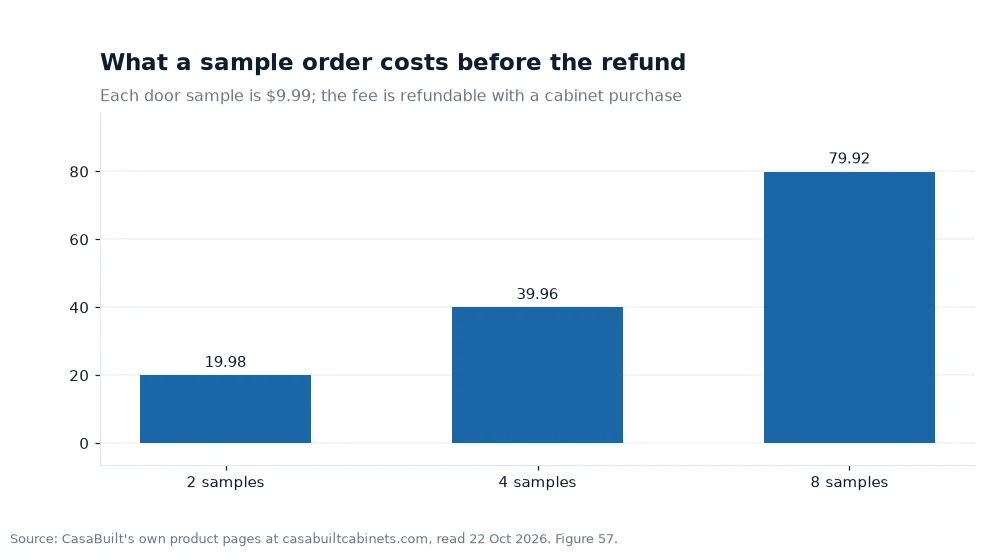
Ordering eight samples sounds excessive until the arithmetic is done. For most buyers the practical route is an rta cabinets sample in each shortlisted finish at $9.99, with the fee returned against a cabinet purchase. The table below shows what a sample order costs at checkout before any refund, at the standard $9.99 per door. The premium finishes sit outside this grid: Black Quarterline is listed at $19.50 and Beach Impression at $22.00, so a mixed order needs a manual total.
| Samples ordered | Cost at checkout | Refundable with a cabinet purchase | Net cost if you buy cabinets |
|---|---|---|---|
| 2 samples | $19.98 | $19.98 | $0.00 |
| 4 samples | $39.96 | $39.96 | $0.00 |
| 8 samples | $79.92 | $79.92 | $0.00 |
The last column is the argument for ordering generously. A buyer who intends to purchase cabinetry is not spending $79.92 on samples; they are advancing it. The risk is not the money but the drawer full of doors that never get compared, which is why the samples should be ordered as a set with a question attached to each one.
What a sample cannot tell you
A door does not describe a box. The carcase is a separate decision: 1/2-inch birch plywood with a natural birch interior, a 3/4-inch by 1-1/2-inch solid birch face frame, soft-close concealed hinges with six-way adjustment, and drawers in 5/8-inch rubberwood with dovetail joints. None of that is visible on a sample, and all of it outlasts the paint. Read the specification page in the same sitting as the sample order.
The sample also cannot tell you how the finish behaves after a year of steam and sunlight. What it can tell you is whether the paint was applied properly in the first place, which is the best available proxy. Look at the coverage inside the panel recess, where a thin coat shows as a lighter patch, and at the edge radius, where a heavy coat shows as a bead.
Finally, the sample cannot price the room. That is a measurement job plus a design, and CasaBuilt delivers a 3D plan in 24-48 hours from submitted measurements. The sample confirms the finish, the measurement confirms the fit, and neither replaces the other.
Worked example: the cost of looking properly
The chart prices three sample orders: two samples at $19.98, four at $39.96 and eight at $79.92. Divide each total by the $9.99 unit price and the arithmetic returns the count. $19.98 divided by $9.99 is 2. $39.96 divided by $9.99 is 4. $79.92 divided by $9.99 is 8. Each step of two samples adds $19.98, and the three totals sit $59.94 apart from end to end.
Put that against the cabinet it describes. A 15-inch base cabinet is listed at $238.24, so eight samples cost $79.92, or 34% of one small base cabinet. Sixteen samples — the full standard library — would be $159.84, still less than a single 24-inch base at $459.26, and that assumes none of the fee comes back.
The comparison that matters is against a mistake. Ordering one door in the wrong finish and discovering it when the run is hung means living with it or replacing it; ordering eight samples and rejecting five costs nothing if the kitchen goes ahead. The $79.92 is a deposit on a decision, and the refundable structure means the deposit returns when the decision is made.
Frequently asked questions
Does the sample fee come back?
Yes. The $9.99 sample price is refundable with a cabinet purchase, so a buyer who goes on to order cabinetry is not paying for the samples in the end. The two premium finishes are priced separately at $19.50 for Black Quarterline and $22.00 for Beach Impression, and those are shown on the product page rather than in the standard sample price.
Can one sample tell me whether the door is well made?
It can tell you a lot about the finish: coverage, edge continuity, panel flatness and the join between frame and panel. It cannot tell you about the box, so pair the sample with the published specification — 1/2-inch birch plywood, a solid birch face frame, soft-close six-way hinges and dovetail drawers.
How long should I keep the samples?
Until the cabinets are delivered, and preferably until the kitchen is finished. The door in your hand is the reference for anything that arrives with a different sheen or a different edge. Store them flat rather than leaning, in the room they were chosen for, and keep the packaging so they can be returned if the order changes.
Order three, then decide
Pick the finish you expect to choose, one contrast, and one wildcard, and hold all three against the wall on a bright morning and again at night. Run a thumb along each edge and tip each door toward the light. Then check the specification page for the parts the sample cannot show. The cheapest part of a kitchen project is the part that prevents the expensive one, and the sample order is that part.
Figures quoted here come from the manufacturer's own website, read 22 Oct 2026[1].